
Inequality profiles

 Southampton Inequality Profiles
Inequality is defined as differences in experience or outcome between groups of people due to social, geographical, biological or other factors. These differences have a huge impact because they result in people who are worst off experiencing poorer outcomes, often resulting in reduced opportunities, poorer health and shorter lives.
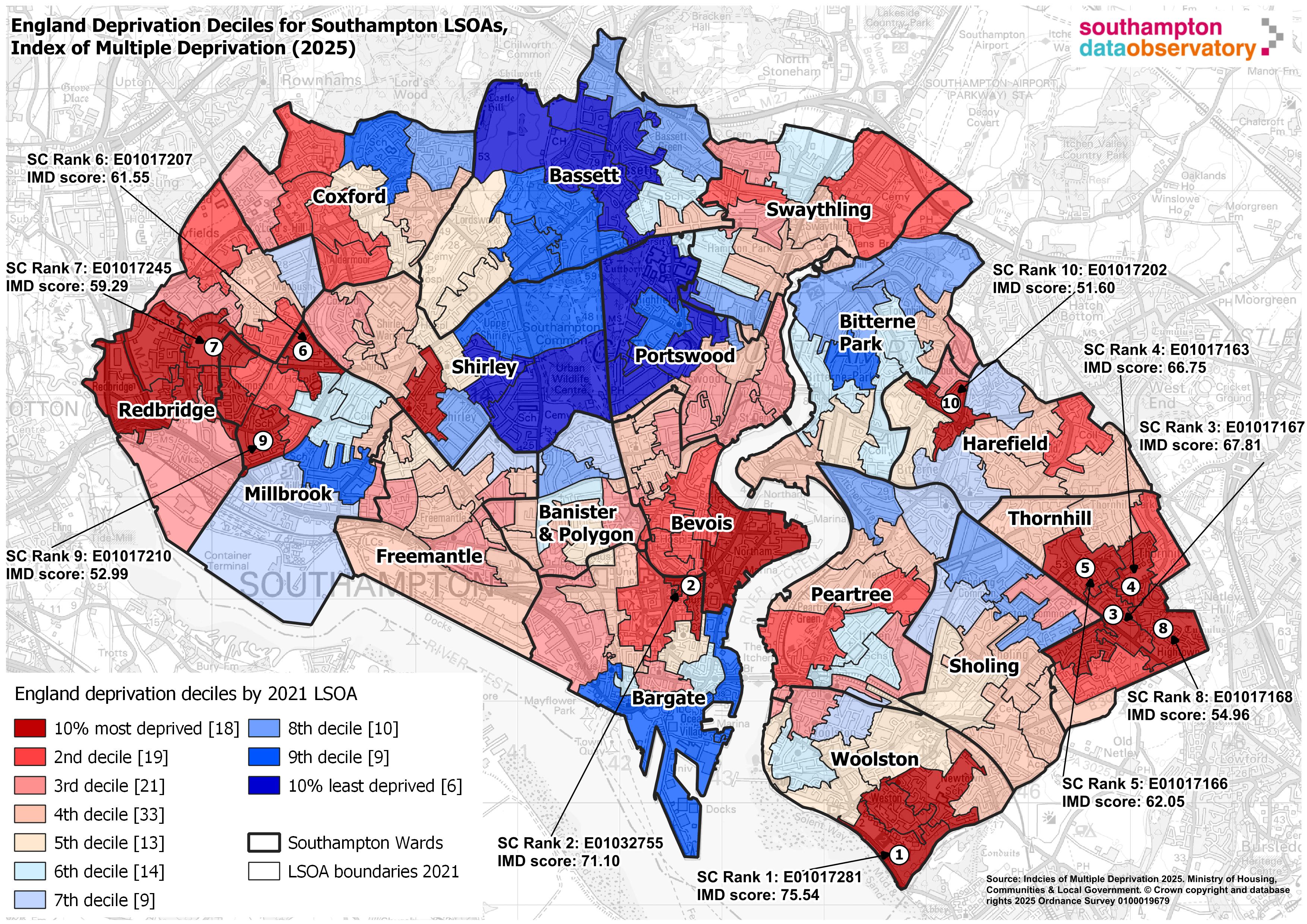 One method to measure these inequalities is by analysing differences in outcomes between the 20% most deprived neighbourhoods in Southampton, compared with the 20% least deprived neighbourhoods as defined by the Index of Multiple Deprivation (IMD). For more context on inequalities and deprivation, please refer to the deprivation and poverty and health inequalities pages.
The latest IMD was released in 2025 and provides a relative ranking of deprivation for all 33,755 2021 Lower Layer Super Output Areas (LSOAs) in England. Based on this relative ranking, LSOAs can be grouped into ten equal groups, known as deciles, or five equal groups known as quintiles. Inequality profiles have been produced for England deprivation quintiles (based on the rank of Southampton LSOAs relative to all LSOAs in England) and for local Southampton deprivation quintiles (calculated from just the ranking of the 152 Southampton 2021 LSOAs). It is important to consider both national and local deprivation quintiles when monitoring inequalities. The purpose of the inequality profiles is to improve the understanding of the level of inequality across various outcomes in Southampton, as well as monitoring the gaps over time.
The inequality profiles can be viewed using the interactive inequality profiles Power BI report available in the resources section. This report provides data for a range of indicators grouped into various themes, including demography, economy, community safety, health, education and social care.
Resources
Inequality profiles dashboard
This dashboard provides profiles for national and local deprivation quintiles in Southampton. These profiles pull together information across a range of topics including demography, economy, community safety, health, education and social care. In order to better understand the level of inequality in Southampton and whether the inequality gap is improving over time.
Inequality profiles dashboard
Visualisation
Index of Multiple Deprivation (IMD 2025)
The Ministry of Housing, Communities and Local Government (MHCLG) published the latest Indices of Deprivation (IoD) in October 2025. The Indices of Deprivation 2025 provides a relative ranking of areas across the country according to their level of deprivation and is the primary source of information on deprivation in England. The IMD measures deprivation at neighbourhood level known as 2021 Lower Super Output Areas (LSOAs), which contain approximately 1,500 people. In addition, a series of maps are available below illustrating the deprivation decile assignment for each of Southampton’s 152 LSOAs for each domain of deprivation. Southampton is ranked 76th (previously 55th in IMD 2019) most deprived based on average rank of LSOAs across 296 local authorities.
IMD2025 - Summary 2019 to 2025
pdf | 9.1 MB | 31.03.2026
IMD2025 - Analysis 2019-2025
pdf | 11.7 MB | 31.03.2026
IMD 2025 dashboard
This dashboard presents and in depth analysis of the Index of Multiple Deprivation data by two geographies LSOA neighbourhoods and lower tier local authorities.
IMD 2025 dashboard
Visualisation
Geographies dashboard
This dashboard draws together a selection of interactive maps on various topics all in one place. These maps range from geographical boundary maps and points of interest for Southampton.
Geographies dashboard
Visualisation
Southampton population dashboard
The dashboard presents a range of population data to provide intelligence on Southampton's resident and GP registered population to help drive strategic decision making. Data in this dashboard is compiled from a range of publicly available sources. Including Small Area Population Forecasts (SAPF), Mid-Year Population Estimates (MYE), Subnational Population Projections (SNPP) and GP Registered Populations. Please note that SAPF figures in the dashboard are the sum of all Lower Level Super Output Areas (LSOAs) and may not be the same as other published figures.
Southampton population dashboard
Visualisation
ONS - Subnational indicators explorer
Compare a local authority and the UK average (median) local authority by different indicators, such as weekly pay and healthy life expectancy.
ONS - Subnational indicators explorer
Visualisation
Last updated: 09 October 2026